Traffic lights and signals
Overview of lights, arrows, and signals that control driving.
Part 32 of 50: Traffic Management and Intersections
How to Read the Signals
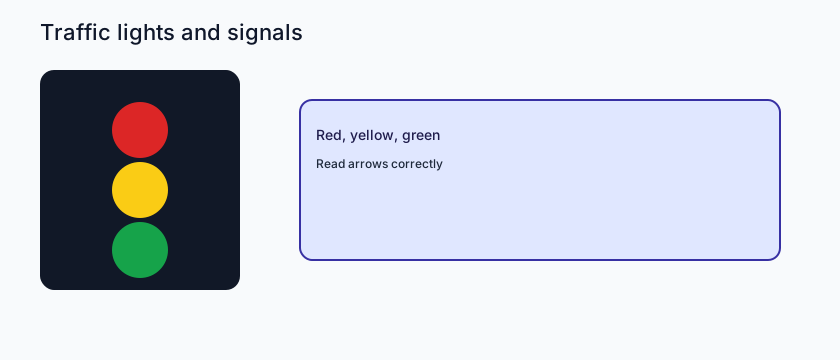
| Signal | What it Means | What You Do |
|---|---|---|
| Red | Stop | Stop before the stop line |
| Yellow | Stop if possible | Brake gently, avoid hard braking |
| Green | Go if clear | Check cross traffic |
| Arrow Light | Only applies to the direction of the arrow | Follow the arrow and yield |
Checklist at Signal-Controlled Intersections
- Look for arrows that give specific rules.
- Read signs and markings, see signs and road markings .
- Consider lane choice early with complex intersections and lane choice .
Previous Part
Next Part
- Continue to complex intersections and lane choice .
How to recognize this topic on the test
On the class B theory test, traffic lights and signals is usually tested through a practical situation, not as an isolated fact. Read the whole question before looking at the answer options. Ask yourself who has responsibility, which risk is greatest, and what gives the best safety margin.
- Connect the rule to a practical driving situation: what do you see first, who is affected, and which action gives the best safety margin?
- Look for small details in the question, such as signs, speed, visibility, road conditions, positioning and whether another road user has already started an action.
- Choose the answer that shows early risk awareness. On the theory test, the right answer is often the one that prevents danger, not merely the one that is barely legal.
Common mistakes to avoid
- Memorizing a rule without connecting it to positioning, speed and cooperation.
- Overlooking words such as “before”, “after”, “at” or “may” in the question.
- Choosing an answer that is legal in theory but poor defensive driving in practice.
How to practice further
Use this article as a checklist after taking a practice test. If you answer a question about this topic incorrectly, write down what you missed: rule, sign, positioning, speed, responsibility or an exception. Then take a few new questions on the same topic before mixing it back into a full test.
Read also:
Read next
More in Class B course
Accidents involving vulnerable road users
Special procedures and considerations for accidents involving pedestrians and cyclists.
Accidents, reporting and first aid
Checklist for safe handling of accidents and proper notification.
Adapted speed and hidden danger
What adjusted speed means in practice, and how you anticipate hazards you cannot see.
Age limits and practice driving
Everything about age limits for class B and what is required for private practice driving with a companion.