What kind of syllabus is covered on the theory test?
Complete overview of the curriculum for the theory test with topics, typical tasks, difficulty level, and recommended practice.
Overview
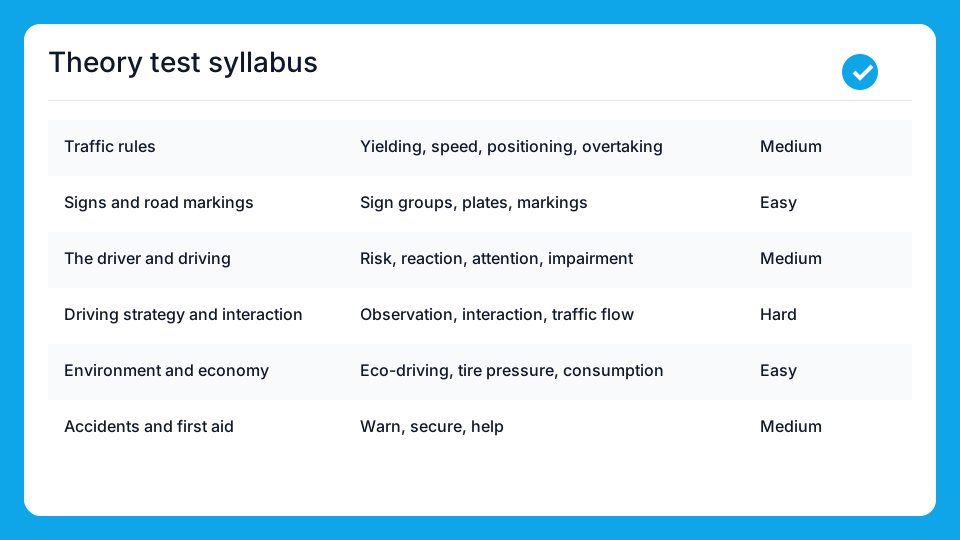
Many wonder what is actually included in the curriculum for the theory test. Below you will find a structured overview of the most important topics, example types, and tips on how to practice. Also read: How to pass the theory test and How to practice for the theory test . For more context, see information about the car theory test , and practice for free here: free theory test . Deep dive into safety questions and consider a basic course for structure.
Topics on the theory test| Topic | What is tested | Typical tasks | Difficulty |
|—|—|—|—| | Traffic rules | Right of way, speed limits, positioning, overtaking | Which vehicle has right of way, correct lane, when you can overtake | Medium | | Signs and road markings | Sign groups, sub-signs, markings | Interpretation of sign combinations, temporary signs | Easy–medium | | Humans and driving | Risk, reaction, attention, intoxication | What affects reaction time, fatigue, distraction | Medium | | Driving strategy and interaction | Use of gaze, interaction, traffic flow | Choice of speed and position in scenarios | Medium–difficult | | Environment and economy | Eco-driving, emissions, tire pressure | Which gear is best, tire wear and fuel consumption | Easy | | Accidents and first aid | Alerting, securing, initial measures | Correct order at accident scene, CPR principles | Medium | | Vehicle and safety | Braking distance, tires, lights, load | Calculate braking distance, correct use of lights, load securing | Medium–difficult | | Numbers and physics | Simple calculations, ratios | Distance, time, speed, braking-/reaksjonsstrekning | Medium |## Important Knowledge and Concepts
- Reaction time vs. braking distance, and what affects them
- Main rules for right of way, roundabouts, and lane choice
- Sign groups: warning signs, prohibition signs, mandatory signs, information signs
- Securing an accident site: alert, secure, help
- Eco-driving: steady acceleration, correct gear, correct tire pressure
Mini-formulas and Memory Aids
- Reaction distance ≈ speed(km/h) × 3 ÷ 10
- Braking distance increases approximately with the square of the speed
- Double the speed ≈ four times the braking distance
How to Practice the Curriculum Purposefully
- Get an overview: Read briefly about each topic and mark your gaps
- Practice actively: Solve exercises and explain why the correct answer is correct
- Timed practice: Take a full test with a time limit
- Error journal: Note what you get wrong and why
- Alternate topics: Mix exercises for better learning
Examples of Question Types
- Which vehicle has the right of way in a given situation
- What does the combination of this sign and the sub-sign mean
- Which light is correct to use in fog
- What is the correct order when you arrive first at an accident scene
- Which measures reduce fuel consumption the most in city driving
Further reading
- Question types and traps: What kind of questions appear on the theory test?
- Practical strategy: How to pass the theory test
- Study technique: How to practice for the theory test
- About the test and structure: Car theory test
- Free practice: Free theory test
- Critical topics: Safety questions
- Structured progression: Basic course
Read next
More in The theory test
Error journal and repetition: learn from your own mistakes
A practical template and routine for using your mistakes as learning.
How to pass the theory exam
The theory exam is what many call the theory test. Here is everything you need to know to pass.
How to pass the theory test?
A practical step-by-step guide with a learning plan, practice methods, and exam tactics to pass the theory test.
How to practice for the theory test?
This is how you make a simple plan, practice smart, and use the right resources to pass the theory test.